Make Classroom Transitions Easier to Follow
A transition is easier to manage when students can see what is ending, what comes next and what to do in between. Clear signals, ready materials and a steady sequence make that expectation visible.
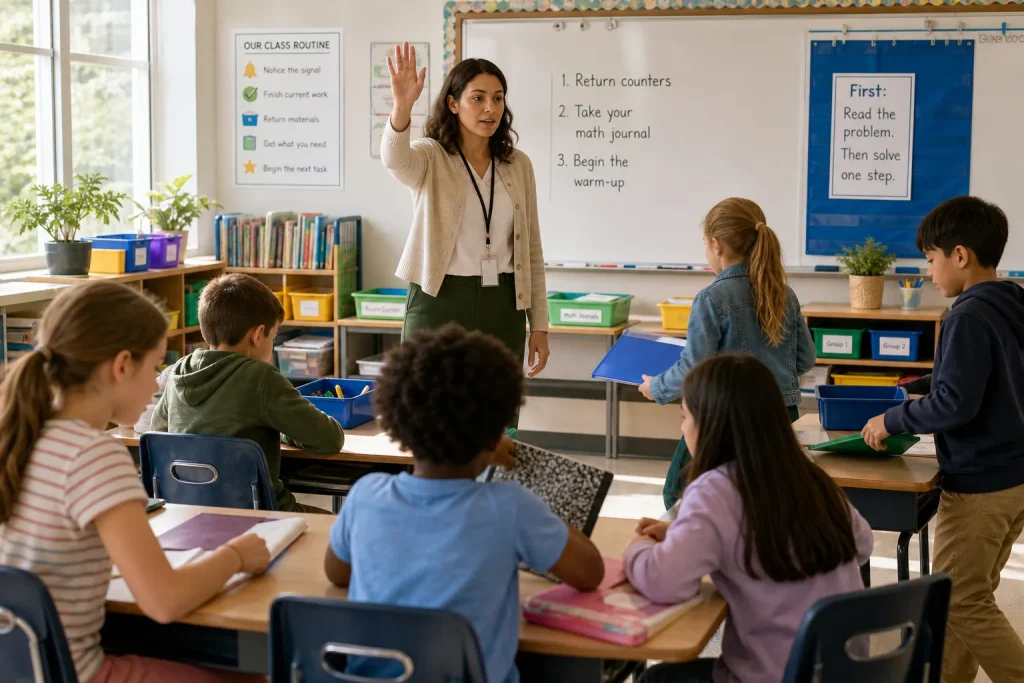
A transition is easier to manage when students can see what is ending, what comes next and what to do in between. Clear signals, ready materials…
Classrooms · 9 min read
The class is halfway through a lively discussion when the teacher raises a hand and says, “Put everything away and get ready for the next activity.” A few students close their notebooks; others keep talking, look around for supplies or ask what they need. The next lesson has not begun, but the room is already full of competing instructions.
Transitions are often treated as brief pauses between the parts of a lesson. In practice, they are activities of their own: students must notice a change, stop one kind of work, organize materials, move or reset, and begin something different. When those actions are predictable, learners can spend less attention guessing what is expected and more attention on the work ahead. The aim is not silence or speed for its own sake. It is a clear route from one task to the next.
Make the change visible before it happens
A useful transition begins with an understandable signal. It might be a spoken phrase, a chime, a raised hand, a projected slide or a consistent combination of these. The specific signal matters less than its meaning: students should learn that it marks a change and tells them to attend for the next direction.
Give the signal before adding several instructions. If the teacher speaks while students are still handling materials or talking with partners, some will miss the message and others will act on only part of it. A brief pause after the signal creates room for attention to shift. The teacher can then state what is ending and what is beginning: “Finish the sentence you are writing. Then put your notebook in the tray and bring your reading folder to the meeting area.”
For a longer activity, an advance notice can make the ending less abrupt. A reminder such as “You have time for one more idea before we switch” helps students bring their current work to a stopping point. It need not be a countdown. A verbal cue or a change on the board can serve the same purpose, provided it is familiar and consistent.
Signals also need to work for the learners in the room. A sound alone may be easy to miss in a busy classroom; a visual cue can support students who are focused on a page or who do not process spoken directions quickly. A short written direction can help students who need to refer back rather than remember a string of steps. Using a spoken cue alongside a visible one is often a simple way to make the transition easier to follow.
Prepare the destination, not just the departure
Students cannot move smoothly toward an activity if its materials are still being gathered or its location is unclear. Before asking the class to switch, make the next task ready to receive them. That may mean placing science trays on group tables, writing a reading prompt on the board, opening the needed document on classroom devices or putting a sample response where students can see it.
Preparation includes deciding what students should carry, leave behind and do first. “Get ready for writing” is broad; it does not tell a learner whether to bring a folder, find a pencil, move seats or open a particular page. A more useful direction names the materials and the first action. If there is an expected place to sit, identify it. If students are staying at their desks, say so rather than relying on them to infer it.
Keep the amount of information manageable. A sequence of many spoken directions is difficult to retain while students are also packing away, standing and moving. A short list on the board can hold the details in place: “Return counters. Take your math journal. Begin the warm-up.” The list is not decoration; it is an external memory aid that students can consult while carrying out the change.
Materials can also be arranged so that the transition itself includes less searching. Labeled bins, designated tray locations and clearly marked group supplies make the next step easier to identify. These systems do not need to be elaborate. A few consistent labels, used the same way over time, can be more helpful than a detailed organization scheme students must relearn.
Use a sequence students can learn
A dependable transition has a recognizable order. For example: notice the signal, finish or mark the current work, return shared materials, collect what is needed next, and begin the opening task. The order can change for a particular lesson, but keeping the usual pattern stable gives students a structure they can anticipate.
Teach that pattern directly rather than expecting students to pick it up by watching others. Introduce the signal, explain what the steps mean, and practise the sequence when there is enough room to pause and clarify. If students are moving from desks to the carpet, show where materials go and where they should sit. If they are changing from independent reading to partner discussion, explain how to put away books and find a partner. A calm rehearsal can make the real transition less dependent on repeated reminders.
Not every learner will follow the sequence in the same way or at the same pace. Some may need an extra moment to finish a thought; others may need a visual reminder or a defined role in the movement of materials. A predictable routine should make participation easier, not turn a single pace into a test of compliance. Allowing a student to mark a place with a bookmark, for instance, can make it easier to leave a text without losing track of the work.
Consider transitions that involve movement particularly carefully. Name the route or destination, clarify what students should carry, and explain how shared items will be handled. If several groups need the same supplies, designate who collects them or place materials at each work area in advance. The less students have to negotiate while moving, the more attention remains available for the new task.
Make the first action of the next task obvious
A transition is not complete merely because students have reached the right seats or collected the right supplies. They also need to know how to start. An opening action gives them a clear point of entry: read the question on the board, sort the picture cards, write one observation, or listen for the first example.
This first action should be visible and appropriately small. A student arriving at a station might see a card that says, “Look at the diagram. Mark one part you want to ask about.” A class settling for a read-aloud might see the book displayed and hear, “Keep your hands free and look at the illustration.” These directions connect the physical change to the learning activity, rather than leaving a gap in which students wait for further instructions.
It can help to leave the opening task where students can see it before they move. A projected prompt, a board note or a card on each table can serve this purpose. If the task depends on a teacher explanation, make that clear too: “Bring your journal and sit at your table; I will give the first direction once everyone is seated.” The key is to distinguish between what students can start independently and what they should wait to hear.
Notice where the routine stops making sense
A transition that works for one activity may not fit another. Moving from a quiet task to a whole-class demonstration calls for different preparation than shifting from a discussion to independent writing. Keep the basic signal familiar, but adapt the materials, route and first action to the task at hand.
When a transition repeatedly stalls, look for the uncertain point rather than assuming students are unwilling to cooperate. Perhaps the signal is hard to notice, the destination is unclear, a supply has no regular location, or the opening task is not available when students arrive. Watch for the moment when learners stop and look around, ask the same question, or begin the wrong action. That moment can point to a missing instruction or an unprepared resource.
Then adjust one part of the routine. If students cannot tell what to carry, add a concise materials cue. If several children reach for the same item, set out one at each table or assign a collector. If students are ready but waiting, provide a visible starting prompt or clarify that they should pause for teacher directions. Small changes to the route are often more useful than repeating the same instruction louder.
It is also worth checking whether the routine asks students to do too much at once. Putting away one set of materials, crossing the room, collecting new supplies and remembering a multi-part direction can create avoidable confusion. Break the sequence into visible stages where needed. A teacher can signal “return the materials” first, then give the movement cue once the room is ready. That approach may take an extra pause, but it can reduce uncertainty and preserve a calmer start.
A hypothetical worked example for a reading-to-writing shift
Hypothetical worked example: Imagine a class finishing partner reading at shared tables. Students have books, sticky notes and pencils, and the next activity is a short individual response at their desks. The constraint is that books must be returned to a shelf across the room, while the writing prompt needs to be visible before students sit down.
The teacher puts the prompt on the board before partner reading ends and places a small basket for sticky notes beside the books. A familiar visual signal marks the change. The teacher says, “Finish the line you are reading. Put your sticky notes in the basket, return the book to its labeled shelf, then take your pencil to your desk. Start by writing one sentence about the character’s choice.” The directions are also written as a brief sequence beside the prompt.
Students can see both where each item belongs and what to do after arriving. A learner who needs more time to finish can mark the page before returning the book. The expected result is not a perfectly silent room; it is a clearer route into writing, with fewer decisions left to guess. The tradeoff is that the teacher has to prepare the prompt and collection point ahead of time. If that preparation is not possible, a simpler transition may be better: keep the books at the desks and begin the response there.
Keep predictability flexible and humane
Clear routines are most useful when they reduce friction without making every moment rigid. A student may need a reminder, a different way to access directions or additional time to complete a change. The teacher can maintain the same sequence while offering support, such as pointing to the written steps, giving a quiet individual cue or assigning a stable place for materials.
Let students know what successful participation looks like. Instead of relying only on “Be ready,” describe the observable actions: “The book is on the shelf, your pencil is on the desk and your first sentence is underway.” Concrete expectations help students check their own progress and help the teacher identify which part of the routine needs attention.
Transitions also provide a chance to preserve continuity. A brief reminder of the link between activities—“Keep the question your partner raised in mind as you write”—can help students carry an idea forward rather than treating each task as a separate start. This connection need not become another long instruction. One sentence can make the purpose of the change easier to understand.
When the signal, materials and next action fit together, a transition becomes more than a way to keep a room moving. It gives learners a dependable path into the next piece of work. Start by making one frequently repeated change easier to see and follow, then keep what helps and revise the part that leaves students guessing.