Build a Study Routine You Can Actually Repeat
Create a study habit around a dependable cue, a small first task and a plan for interruptions, so returning to your work feels manageable rather than all-or-nothing.
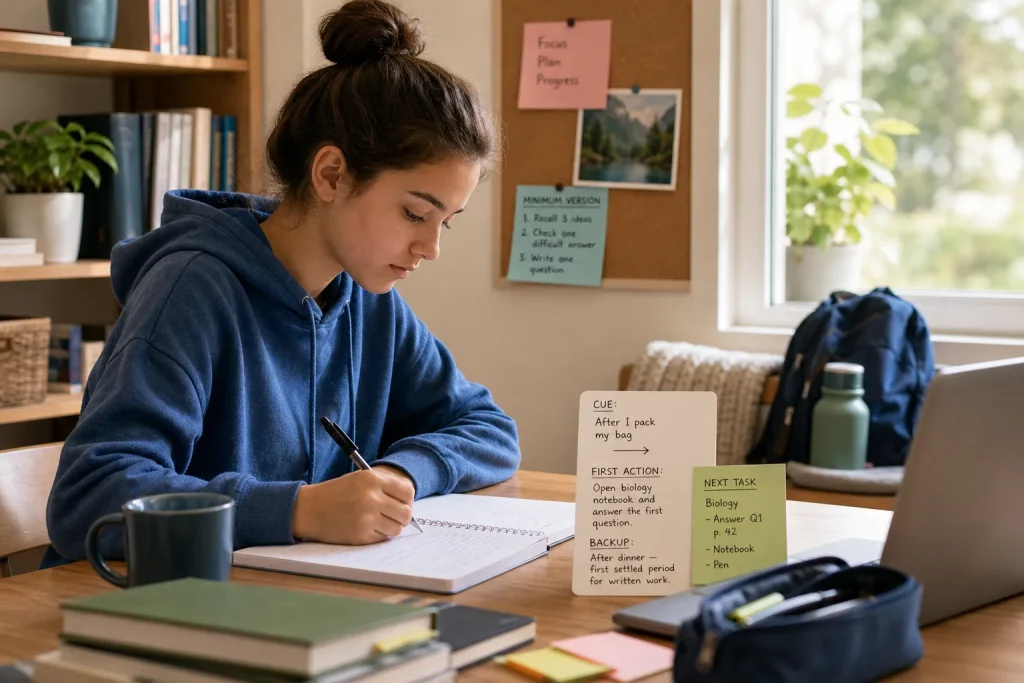
Create a study habit around a dependable cue, a small first task and a plan for interruptions, so returning to your work feels manageable rather than…
Learning · 9 min read
At the kitchen table, a student opens a notebook after dinner, sees a long list of unfinished work, and closes it again to answer a message. The problem may not be a lack of commitment. The routine has no reliable beginning, and its first demand is too large. A repeatable study habit starts with a cue you can recognize, a first action you can begin even on a tiring day, and a way back after plans change.
This approach is not a promise that every session will be focused or that a routine will fit every week. It is a structure to make starting less uncertain. Build it in order: choose when and where it can happen, decide what counts as starting, connect the cue to a concrete task, then review and adjust without treating interruptions as failure.
Choose a cue that already belongs to your day
A cue is an event that tells you it is time to begin. It works best when it is specific and likely to occur, rather than an intention such as “study later.” Ordinary transitions can serve: putting away lunch, returning home from school, finishing a shift, or sitting down at the library before a regular activity.
Look at the shape of your actual week before choosing. Consider when you have access to a quiet or reasonably comfortable place, when you can reach the materials you need, and which obligations regularly take priority. A cue should fit around those realities. If your afternoon changes from day to day, a fixed clock time may be a poor anchor. “After I pack my bag for tomorrow” may be more dependable.
Choose one main cue for now, not a different elaborate ritual for every subject. You can add variations later. Then name the location or setup that follows it: for instance, at the library desk with the relevant book and notebook ready. A defined place helps make the cue actionable, but it does not have to be a dedicated study room. A corner of a shared table can work if you know where to sit and what to clear.
It is also useful to identify a backup cue. If your usual after-school window disappears, what is the next plausible opening? The backup might be the bus ride for reviewing flash cards, or the first settled period after dinner for written work. Match the task to the setting: a noisy trip may suit recall practice better than an essay that requires concentration. A backup is an option, not an extra obligation.
Make the first action small and visible
Once you have a cue, decide what you will physically do first. “Work on biology” is vague; it leaves you to choose a task at the moment you are already trying to begin. “Open the biology notebook and answer the question at the top of the page” gives your hands somewhere to go.
Choose an opening task that is meaningful but modest. You might read one assigned section and mark a question, attempt the first problem on a worksheet, or write down what you remember about a topic before checking your notes. The aim is not to make all studying effortless. It is to remove the unnecessary negotiation that can happen before useful work starts.
Keep the starting point small enough to survive an ordinary low-energy day. If beginning always requires sorting a pile of papers, finding a charger, searching the school platform, and deciding which assignment matters, prepare those materials earlier where possible. Put the textbook and pencil case together, save the correct page, or write the next task on a sticky note before ending the previous session. A short handoff note can prevent tomorrow’s session from starting with a fresh round of decisions.
Set a stopping point as well as a starting point. You could finish the first defined task, complete a planned block of work, or stop when you reach a natural break in the material. The stopping rule should be clear enough to protect other responsibilities and flexible enough to allow more work when it makes sense. A routine is not a demand to keep going indefinitely.
Give the session one job at a time
After the first action, choose a task that fits the time and attention you have. A short session can still be useful if it has a clear purpose: review vocabulary, correct a set of errors, outline a paragraph, or prepare questions for class. Trying to touch every subject in every session often creates a busy list without a satisfying sense of progress.
Use a simple task note with three parts: subject, next action, and materials. For example: “History — compare the two causes in my notes — notebook and textbook.” This is more helpful than writing “history” alone, because it records the decision you would otherwise have to make later. Keep the note where you will see it at the cue: in the front of a planner, beside the laptop, or in the relevant folder.
Choose methods that require you to work with the material, rather than only keep it open in front of you. After reading a page, close the book and explain the main idea in your own words. For a language, retrieve words from memory before checking them. In mathematics, attempt a problem and then inspect the worked solution to locate the step you missed. The task should match what you need to learn, not merely what is easiest to mark complete.
If a task is too large to fit the session, define the next visible piece. “Write the report” can become “list the evidence I will use in the first section.” “Study for the test” can become “make a question from each heading in this chapter.” A smaller action is not a substitute for the larger assignment; it is a way to create a usable entry point.
Prepare for interruptions before they happen
Schedules change. A family responsibility, a late bus, illness, a demanding school week, or a change in work hours can interrupt even a well-chosen routine. If your plan assumes an uninterrupted week, the first disruption can make it feel unusable. Instead, decide in advance what you will preserve when time is tight and how you will resume when it returns.
Keep a minimum version of the routine: one brief, purposeful action that maintains contact with the material. That could mean recalling a few key ideas without notes, checking one difficult answer, or writing down the question you need to ask in class. The minimum version is not meant to replace a full session forever. It is a flexible option for days when the ordinary plan does not fit.
For an interruption that takes you away for longer, leave a restart note before you stop, if you can. Record the last thing you completed and the next action. “I finished the first two questions; next, draw the diagram and label the parts” is more useful than “continue science.” If you did not have a chance to leave a note, spend the first few minutes back finding your place and choosing one next action. Re-entry is part of the routine, not evidence that the routine failed.
Be careful not to respond to a missed session by doubling the next one automatically. That can make the routine feel costly and crowded. First identify what matters most: an approaching deadline, a topic that remains unclear, or a task that can wait. If the workload is persistently difficult to manage, speak with a teacher, adviser, or another appropriate support person about priorities and available help.
Notice what makes the routine easier or harder
After several attempts, look for practical patterns rather than judging yourself. Did the cue occur when expected? Were your materials available? Was the first task clear? Did the place make it possible to concentrate? A simple note after each session can capture the answer: “started after dinner; laptop update delayed me,” or “library cue worked; question list was ready.” You do not need a detailed tracker. Record only information that might change your next decision.
Make one adjustment at a time. If the cue is unreliable, attach the session to a steadier transition. If setup takes too long, gather the materials in advance. If you begin but drift among assignments, write a single next action before the cue. If the planned work regularly exceeds the available time, narrow the session’s purpose or choose a more realistic window. Changing several parts at once makes it harder to tell which change helped.
Keep what works and remove needless ceremony. A playlist, timer, special desk arrangement, or elaborate planner may help some learners, but none is required. The useful question is whether a tool supports the next action. If checking an app becomes another task to manage, a paper note may be simpler. If a timer makes you anxious, use a natural stopping point instead.
Hypothetical worked example: a student with changing evenings
Imagine a student who has a mathematics quiz coming up, shares a bedroom with a sibling, and cannot count on a quiet evening at home. The student has a planner, a mathematics notebook, and access to a public library after school on some days. The constraint is straightforward: the same place and time will not be available every day.
First, the student chooses packing the school bag as the main cue. On days when the library is open and there is enough time before the ride home, the student sits at a library table, takes out the notebook, and attempts one problem marked for review. On other days, the student uses a quieter available period at home, if one occurs. Before leaving the library, the student writes the next problem number and any confusing step on a note tucked into the notebook.
For a crowded evening, the minimum version is to cover the worked solution and explain the first step from memory, then check the notebook. If a day is lost to a family obligation, the student returns by reading the restart note and attempting that next problem, rather than trying to recover every missed minute. The expected result is a routine with a recognizable beginning and a manageable way to resume; the tradeoff is that some sessions will be shorter or happen in less ideal surroundings. This example is hypothetical, and its details would need to change for another student’s schedule and study needs.
Keep the routine open to revision
A study routine should serve learning, not become a separate measure of worth. If a cue stops fitting, choose another. If a subject needs a different kind of practice, change the first task. If a new term alters your timetable, rebuild the routine around the transitions that remain. You are preserving the helpful structure, not defending every old detail.
When you next finish studying, leave yourself a clear place to begin: put the needed materials together and write one specific next action. Then let the next cue do its quiet work. A routine becomes repeatable not because every day goes to plan, but because the return path is already there when it does not.